Departmental Overview
Request Appointment
The department at Chittaranjan National Cancer Institute goes back to the very beginnings of the specialty in India. The department started with radium needles and orthovoltage treatment, and in the 1960s it was among the early users of megavoltage tele-caesium and tele-cobalt teletherapy. The Department of Radiation Oncology at the New Town campus continues that tradition with modern, high-precision radiotherapy, offered at an affordable cost to patients from Eastern and North-Eastern India and neighbouring regions.
Our team of radiation oncologists, medical physicists, radiotherapy technologists and nursing staff trained at leading centres in India and abroad. We work in institutional joint tumour boards with surgical oncology, medical oncology and nuclear medicine colleagues, so that every patient gets a treatment plan that has been discussed and agreed by the team, based on evidence and suited to them.
About Radiotherapy
Radiotherapy uses carefully targeted high-energy radiation to destroy cancer cells while sparing the healthy tissue around them as much as possible. It is one of the main treatments for cancer, and about half of all cancer patients need it at some point in their illness. It is used:
- to cure, either on its own or together with surgery and systemic therapy
- to support surgery, before or after an operation, to lower the chance of the cancer coming back
- for prophylaxis, to prevent spread to high-risk sites
- for palliation, to relieve pain, bleeding, obstruction and other symptoms quickly and effectively
The department regularly offers 3D-conformal radiotherapy (3D-CRT), intensity-modulated radiotherapy (IMRT), volumetric-modulated arc therapy (VMAT), image-guided radiotherapy (IGRT), surface-guided radiotherapy (SGRT), stereotactic radiosurgery (SRS), stereotactic radiotherapy (SRT), stereotactic body radiotherapy (SBRT) and HDR brachytherapy. Anaesthesia support is available for children who need radiotherapy and for brachytherapy procedures.
Faculty and Staff
| Name | Designation | Qualification |
|---|---|---|
| Dr. Debarshi Lahiri | Specialist (SAG); Head of the Department, Radiotherapy | MD (Radiotherapy) |
| Dr. Amitabh Ray | Specialist Gr-I; In-Charge, New Town Campus | MD, DNB (Radiotherapy) |
| Dr. Sayan Kundu | Specialist Gr-I | MD, DNB (Radiotherapy) |
| Dr. Koustav Mazumder | Specialist Gr-II | MD, DNB (Radiotherapy) |
| Dr. Ranti Ghosh | Specialist Gr-II | MD, DNB (Radiotherapy), FRCR(UK) |
| Dr. Bodhisattwa Dutta | Specialist Gr-II | MD (Radiotherapy) |
| Dr. Debjit Ghosh | Specialist Gr-II | MD (Radiotherapy), DNB(Radiotherapy) |
| Dr. Janmenjoy Mondal | Specialist Gr-II | MD (Radiotherapy) |
| Dr. Raka Banerjee | Specialist Grade II (Contractual) | DNB (Radiotherapy) |
Supporting team: Senior residents, MD residents (Radiation Oncology), medical physicists, radiotherapy technologists, oncology nursing staff and co-ordinators.
Clinical Oncology Practice
Along with delivering radiotherapy, the department works closely with the Department of Medical Oncology on systemic treatment for our patients. Decisions on concurrent chemoradiation, chemotherapy, targeted therapy and immunotherapy are taken together, through joint consultation and multidisciplinary tumour boards. Every patient therefore gets a single, coordinated plan in which radiotherapy and systemic therapy are sequenced and combined in the best way for them. Systemic treatment is given in the campus's dedicated Day Care unit.
Disease Management Groups
The department is organised into three clinical units, and each unit handles a defined set of disease subsites. Each unit works within site-specific Disease Management Groups (DMGs) alongside the Departments of Surgical Oncology and Medical Oncology. In practice, every patient's case is discussed by specialists in that particular cancer, a joint multidisciplinary plan is agreed, and the patient is followed up by the same team from diagnosis through treatment and beyond.
Across all the units, patients with oligometastatic disease, bone metastases or brain metastases receive individualised radiotherapy, including stereotactic treatment where it is appropriate.
Clinical Services
The New Town department has a large and growing clinical workload. In 2024–25 it handled close to 19,000 outpatient visits, performed nearly 2,000 CT simulations and over 340 brachytherapy procedures, and about 1,900 patients completed radiotherapy. These patients cover the full range of adult solid tumours, including head and neck, breast, lung, gynaecological, genitourinary, gastrointestinal and CNS cancers, as well as lymphomas, paediatric cancers and metastatic disease.
Treatment Facilities
External Beam Radiotherapy (EBRT)
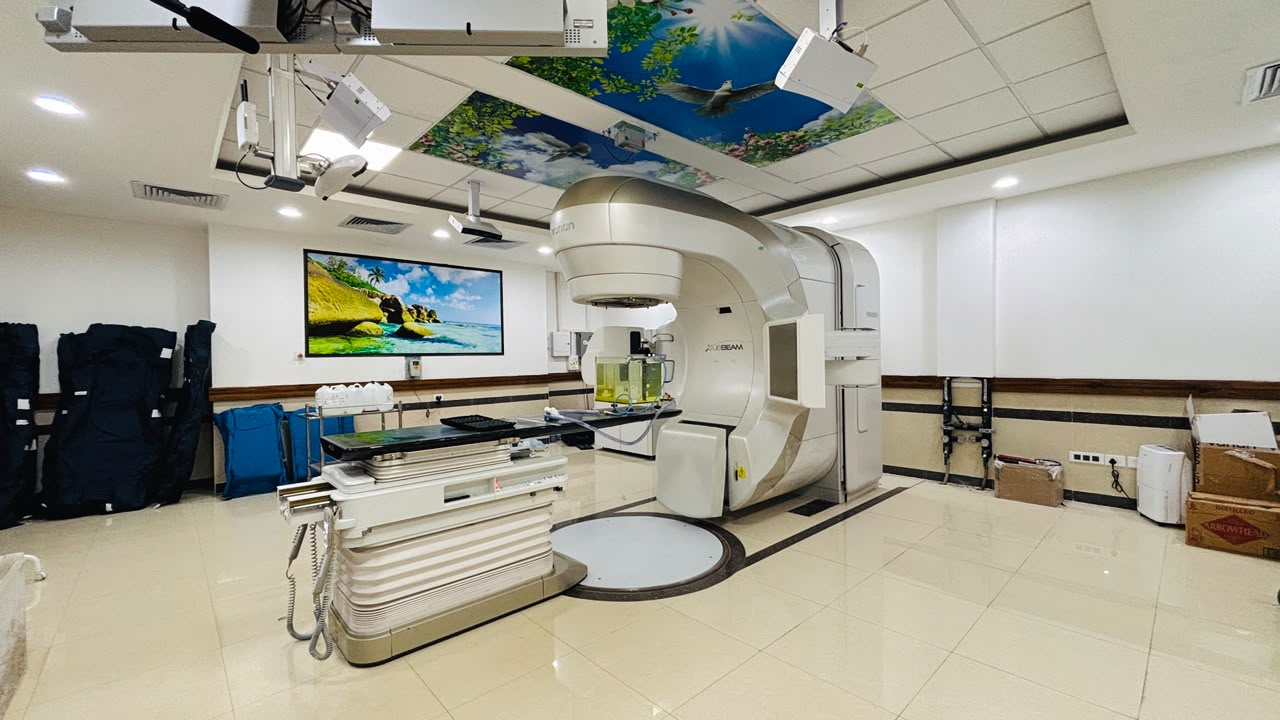
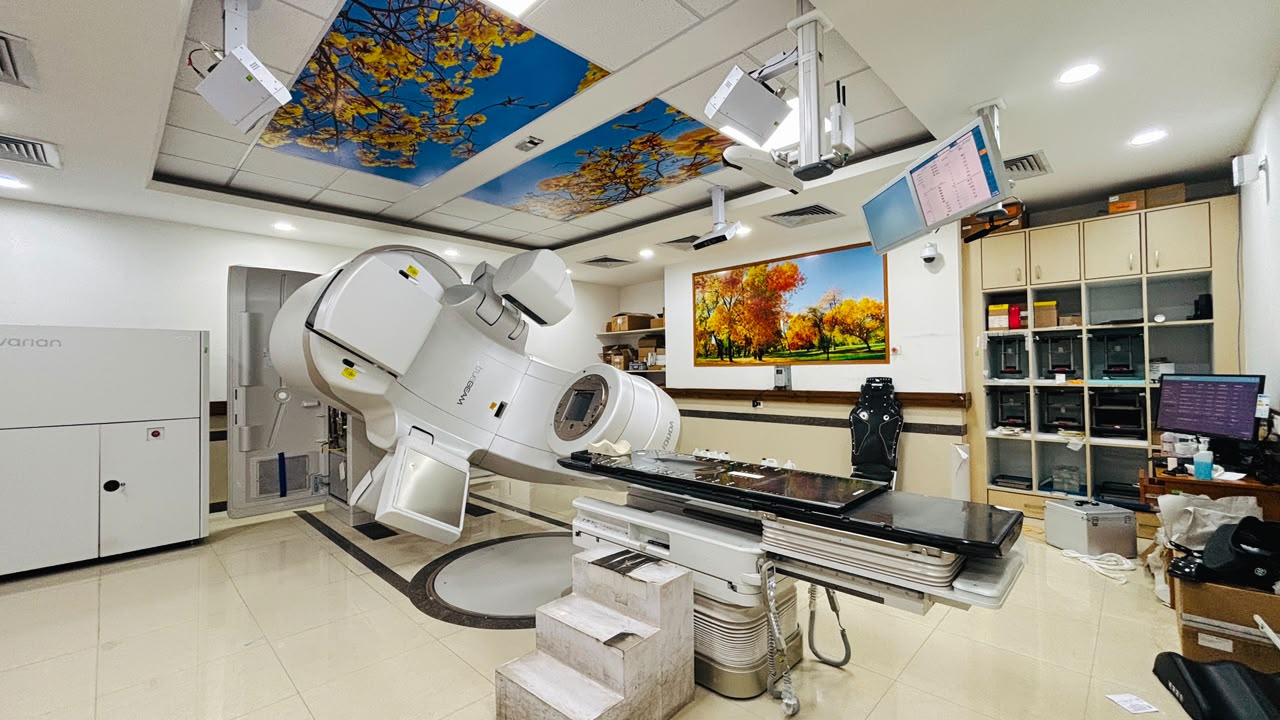
In external beam radiotherapy, radiation beams from a treatment machine are directed at the tumour from outside the body. The department has two Varian TrueBeam SVC linear accelerators, which are state-of-the-art platforms for high-precision radiotherapy. Multileaf collimators shape each beam to the outline of the tumour, and integrated kV and cone-beam CT imaging confirms the tumour's position before every treatment. Together these allow IMRT, VMAT, IGRT, SRS, SRT and SBRT to be delivered with millimetre accuracy, giving the cancer a high dose while sparing the healthy organs around it.
Surface-Guided Radiotherapy (SGRT)
Each linear accelerator has a Vision RT surface-guided radiotherapy system. It monitors the patient's body surface in real time without using any extra radiation. This improves the accuracy and reproducibility of setup, detects any movement during treatment, and makes breath-hold techniques possible, which help protect the heart and lungs.
CT Simulation
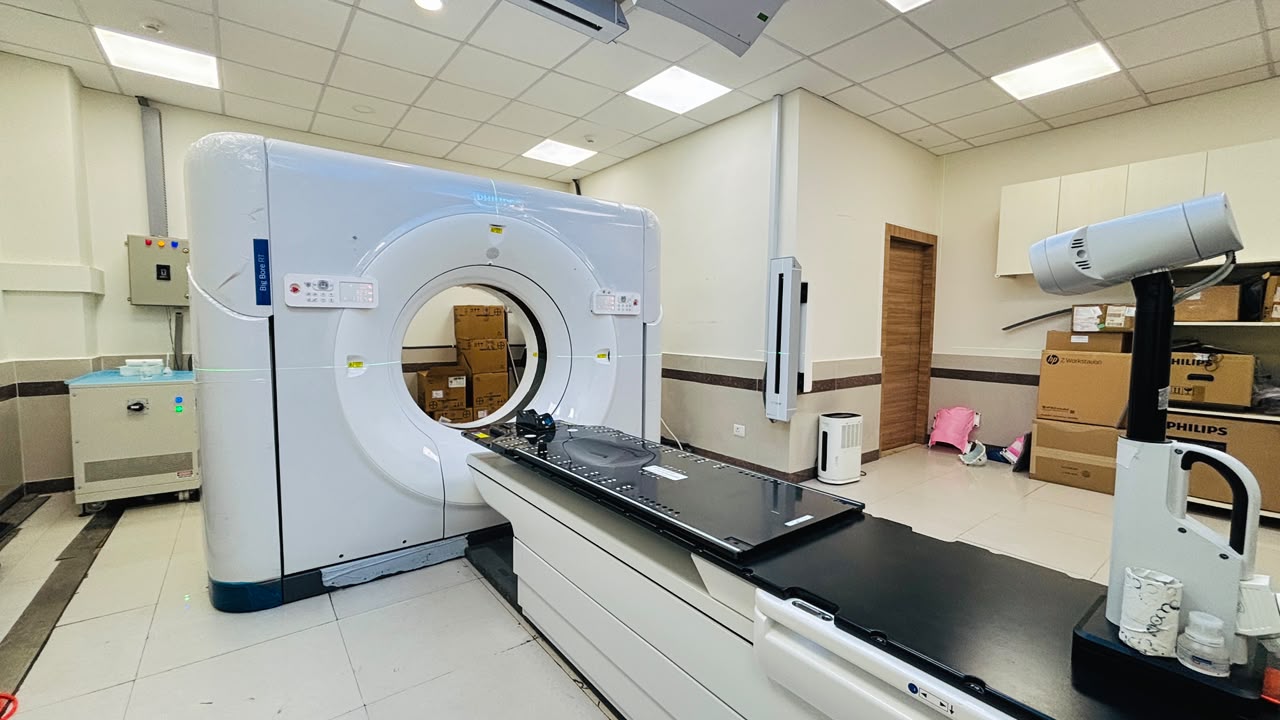
The department has a dedicated Philips Big Bore 16-slice CT simulator. Its wide bore takes patients in their exact treatment position, including bulky immobilisation devices. Where needed, MRI and PET-CT images are fused with the planning CT to outline the tumour more precisely.
Treatment Planning and Information Systems
Planning is done on ten Eclipse external beam treatment planning systems and ten SomaVision contouring workstations, with a dedicated Oncentra brachytherapy planning system. The ARIA oncology information system, running on eighteen workstations, links every step of the patient's journey: scheduling, prescription, delivery and record-keeping.
Brachytherapy
In brachytherapy, a radioactive source is placed inside or right next to the tumour. This gives a high dose to the cancer while nearby organs receive very little. The department has an Elekta Flexitron Iridium-192 high-dose-rate (HDR) afterloading unit with its own dedicated brachytherapy operation theatre, so applicators can be inserted under anaesthesia, imaged and treated in one streamlined, sterile workflow. Image-based intracavitary and interstitial brachytherapy is performed for gynaecological cancers and other sites as appropriate.
Quality Assurance
Every treatment plan and every machine goes through a structured physics quality-assurance programme that follows AERB and international standards.
Academics and Training
The department provides or supports the following programmes:
- MD (Radiation Oncology), recognised by the National Medical Commission and affiliated with the West Bengal University of Health Sciences
- Diploma in Radiotherapeutic Technology (DRT-Tech) and Diploma in Radio-diagnosis Technology (DRD-Tech)
- Internships in DRT (Tech) and Medical Physics, plus clinical training for DRT students from other institutes
- Teaching for the Post-M.Sc. Diploma Course in Medical Physics
Research
The department runs an active programme of investigator-initiated clinical research, including randomised trials and prospective studies. These cover high-precision and stereotactic radiotherapy, hypofractionation, oligometastatic disease, image-guided adaptive brachytherapy, organ-sparing techniques and patient-reported outcomes, across thoracic, genitourinary, gastrointestinal, gynaecological, head and neck, breast and CNS cancers. Faculty regularly publish in peer-reviewed international journals and present at national and international meetings such as ASTRO, ASCO and AROICON.
Looking Ahead
CNCI is in the process of acquiring an adaptive radiotherapy linear accelerator. It will let treatment be re-planned during a course of radiotherapy to follow changes in the tumour and the patient's anatomy, which takes precision oncology a step further.
Our Commitment
What drives us is compassionate care centred on the patient, delivered to the highest technical standard and within reach of everyone who needs it. It is a privilege for us to walk beside our patients and their families through one of the hardest times of their lives.
Departmental Photo Gallery